
Security Guards
Licensed Security Guard Services
Armed and unarmed uniformed officers for commercial buildings, warehouses, construction sites, industrial plants and residential communities, posted to written post orders with supervision and same-day incident reporting nationwide.
- 21+ Years in Business
- A+ Rated
- Veteran Owned and Operated
- Licensed and Insured
- 24/7 Dispatch
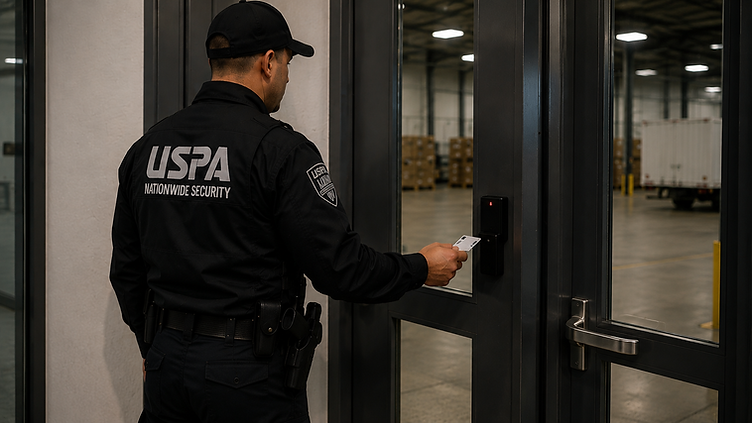
A post needs coverage now?
Call the dispatch line with the property address, the hours and the posture you want. A single post can often be staffed within a day, and urgent assignments are staged from the standing roster in the market.
What USPA guard services cover
Uniformed guards remain the most requested service in the security industry, and also the most unevenly delivered. The difference between coverage that protects a property and coverage that merely occupies it is rarely the badge on the officer's chest. It is the post orders behind the officer, the supervision above the officer, and the written record the officer leaves at the end of every shift.
USPA staffs armed and unarmed uniformed officers for commercial buildings, construction sites, warehouses and distribution centers, manufacturing plants, residential communities and institutional properties. Officers are licensed in the state and municipality where they work, covered by the company's liability insurance with certificates issued for each property that requires one, and briefed on written post orders before their first shift on a site.
The post orders describe the property as it actually operates: the doors that are supposed to be locked and the ones that are not, the delivery windows, the contractor check-in procedure, the patrol routes and their intervals, and the escalation path when something goes wrong. A guard working without that document is improvising; a guard working from it is executing a plan the client approved in writing.
Armed or unarmed: how the decision is made
Armed coverage is assigned on the basis of a documented risk assessment, the client's requirements and the licensing rules of the state where the post sits. It is not a default. Most commercial posts, including warehouses, office buildings and residential communities, operate effectively with unarmed officers, and adding a firearm to a post that does not require one raises licensing complexity, insurance conditions and the vetting bar the officer must clear, all of which are reflected in the rate.
Where the exposure does call for armed coverage, the recommendation is written into the quote with the reasoning attached, so the client's risk manager can see why the posture was proposed rather than take it on faith. Armed officers carry the same written post orders, the same supervision standard and the same reporting obligations as unarmed coverage, and they are re-qualified to the schedule their state requires.
There is also a middle posture worth knowing about: the same officers can run a post in plain clothes or in a low-signature uniform where the property needs presence without a marked guard at the door. High-risk termination support is one common example, where the goal is an officer positioned to observe without turning a routine meeting into a visible event.
What officers actually do on a post
Access control is the core of most assignments. Officers check credentials against the property's own badge system or visitor list, log arrivals that the property requires logged, verify contractors against the schedule the site manager maintains, and turn away or escort anyone who arrives without authorization. On multi-tenant properties the officer is often the first and last human contact a visitor has with the building, which is why the post orders also cover the courtesy standard, not just the security one.
Patrols are the second layer. Officers walk or drive scheduled and randomized rounds across the interior and exterior of the property, documenting each round at its checkpoints. The randomized element matters: a round that arrives at the same time every night is a round an intruder can plan around. Findings are recorded in writing, including the small ones, because the small ones are what a risk manager later needs.
Deliveries and contractors are the third layer, and the one where property losses most often occur. Officers verify drivers against the dock schedule, check seals and paperwork on inbound freight, confirm that outbound loads match their authorization, and keep the log that reconciles who entered, what they carried and when they left. At logistics properties this duty is the assignment; it is covered in depth on the warehouse and distribution security page.
Finally, officers respond to what the property's systems surface. Where camera or alarm infrastructure exists, the post integrates with it: the officer verifies alarms in person, walks the area a camera flagged, and documents what was found or ruled out. When the system outages extend into fire protection territory, the same dispatch organization staffs emergency fire watch coverage so the property never has to choose between guarding the site and meeting the fire marshal's requirement.
Post orders, supervision and reporting
Every assignment begins with a walkthrough and ends with a document. The walkthrough is conducted with the client's site manager, and it produces the post orders: the property's access rules, patrol routes and intervals, emergency contacts, escalation path and the client's own house rules. The document is written, reviewed with the client, and then briefed to every officer before their first shift on the site.
Supervision is layered above the post rather than assumed around it. Field supervisors audit posts in person, verify that rounds and logs are being kept as the post orders require, and act as the escalation point for anything the officer on site flags. On multi-officer or multi-site accounts, one account team holds the standard across locations, so a client with properties in several states sees the same reporting format from every one of them.
Reporting closes the loop. Incidents are documented in writing the same day, in the format the client's risk manager or insurer expects. Round logs, visitor logs and incident files are retained and available. The discipline is simple and it is the reason the documentation matters: what happened is written down, and the record stands on its own without a verbal account.
Where USPA guards are posted
The uniformed guard program supports the properties below. Each link opens the dedicated page for that environment, with the post structure and reporting format specific to it.
Commercial buildings and offices
Lobby presence, visitor and tenant management, after-hours access control and vendor screening for single buildings and multi-tenant portfolios.
Warehouses and distribution centers
Gate, dock and yard coverage, driver and seal verification, trailer yard patrols and cargo theft prevention at the points where custody changes.
Construction sites
Perimeter and equipment coverage after hours, material and tool control, and fire watch staffing when a system impairment requires a documented watch.
Industrial plants and ports
Environment-specific posts written against the facility's own safety program, from PPE zones and escort rules to TWIC credential checks at regulated maritime facilities.
Residential communities
Gatehouse staffing, community patrol, guest and vendor management for HOAs, condominium associations and private estates.
Events and institutions
Short-term and recurring coverage for events and school campuses, staffed through the same dispatch organization as standing posts.
Security guard services in the field

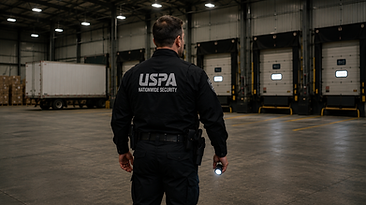
Loading dock patrol at a distribution center.

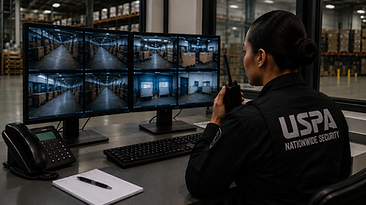
Camera and alarm response desk.
Deployment timeline and pricing
Short-notice staffing is routine. Coverage for a single post can often begin within a day of the request, and urgent posts are handled through 24-hour dispatch rather than a quote queue, with officers staged from the standing roster in the market. Longer-term contracts begin with the site walkthrough and the written post orders, and the first shift follows the client's review of that document.
Pricing is quoted per post. The rate depends on whether the officer is armed or unarmed, the hours of coverage, the market the post sits in, and the post's complexity, including supervision ratio. The quote itemizes what is included: licensing documentation, certificates of insurance issued for the property, the supervision standard and the reporting format, so the client is comparing programs rather than hourly numbers.
Multi-site clients usually see better economics from one account team than from separate vendors in each city, because the pricing, the reporting format and the supervision standard are set once and applied everywhere. New locations are onboarded through the same dispatch desk, and a quote for a new site starts from the existing program's documentation rather than from zero.
Written post orders
Every assignment opens with a walkthrough and a document the client approves.
Licensed and insured
Officers licensed in the state where they work, with certificates issued per property.
Supervised posts
Field supervisors audit rounds and logs in person, on every account.
24-hour dispatch
Short-notice and emergency posts staged from the standing roster in the market.
Security guard questions
How much does it cost to hire a security guard?
Guard pricing is quoted per post. The rate depends on whether the officer is armed or unarmed, the hours of coverage, the market and the post's complexity, including the supervision ratio. Multi-site clients usually see better economics from one account team than from separate vendors in each city. Request a quote with the post details and the operations team will return pricing with licensing and insurance documentation.
Are your security guards licensed and insured?
Yes. Officers are licensed in the state and municipality where they work and are covered by the company's liability insurance, with certificates of insurance issued for each property that requires one. Written post orders, supervision and same-day incident reporting are part of every assignment.
What is the difference between armed and unarmed guards?
Armed officers are assigned based on a documented risk assessment, the client's requirements and state licensing rules. Most commercial posts, including warehouses, office buildings and residential communities, operate effectively with unarmed officers. The decision is usually driven by the exposure at the site rather than by industry convention, and the recommendation is written into the quote with its reasoning.
How quickly can guards be on site?
Short-notice staffing is routine. Coverage for a single post can often begin within a day of the request, and emergency posts are handled through 24-hour dispatch. Longer-term contracts begin with post orders written from a walkthrough of the property.
What do security guards actually do on a post?
The post orders define it: access control and visitor check-in, contractor and delivery verification, scheduled and randomized patrols, camera or alarm response where the infrastructure supports it, and written incident reports filed the same day. Officers document what they observe so a risk manager has a record rather than a verbal account.
What are post orders and who writes them?
Post orders are the written instructions an officer works from: the property's access rules, patrol routes and intervals, delivery and contractor procedures, emergency contacts and the escalation path. USPA writes them from a walkthrough with the site manager, reviews them with the client, and briefs every officer before their first shift. Clients approve the document before the post opens.
Can guards respond to our cameras and alarms?
Yes, where the property's infrastructure supports it. The post integrates with existing camera and alarm systems: officers verify alarms in person, walk the area a camera flagged and document what was found or ruled out. Where a property is moving from an unmonitored to a monitored posture, the quote states plainly what the existing system can and cannot support.
Do you provide guards for short-term or one-day assignments?
Yes. One-day posts, overnight coverage during an event or a system outage, and temporary coverage between permanent vendors are all staffed through the same dispatch organization. Event security is a related option where the assignment involves crowd management rather than property access.
How are officers supervised?
Field supervisors audit posts in person, verify that rounds and logs are kept as the post orders require, and act as the escalation point for anything the officer on site flags. On multi-site accounts the same account team holds the standard across locations, so supervision and reporting stay consistent from market to market.
What is included in the quote?
The itemized rate for the post, the supervision standard, the reporting format, licensing documentation and certificates of insurance issued for the property. The quote states the post orders' scope so the client is comparing programs rather than hourly numbers, and the operations team is available to walk through the document before the assignment is confirmed.
Rated 4.9 by the clients we protect
Reviews are collected from real assignments across the country. Read them directly on Google before you call.
I have their pricing to be very affordable and competitive. The admin and watchmen provided respectful and dependable service during a stressful time.
William BeesleyGoogle reviewVerify This Review
Questions before you commit? Call (800) 214-1448 and ask for references on assignments like yours.
Request security guard services
Give the operations desk the property address, the hours, the posture you want and any supervision requirements, and the written scope, licensing documentation and quote follow before the post opens.
USPA Nationwide Security services are provided, as applicable, by USPA employees, independently owned franchise offices, or certified contractors participating in USPA’s contractor programs established in 2005, with services performed under applicable state and local licensing requirements. USPA is managed by Kingsman Philanthropic Corp., a nonprofit organization whose mission since 2005 has included locating and assisting missing and trafficked girls. Kingsman’s work has been featured on Crime Stories with Nancy Grace.